


Spain’s Reported AI Agent Data Breach: Could Your Business Stop the Same Attack?

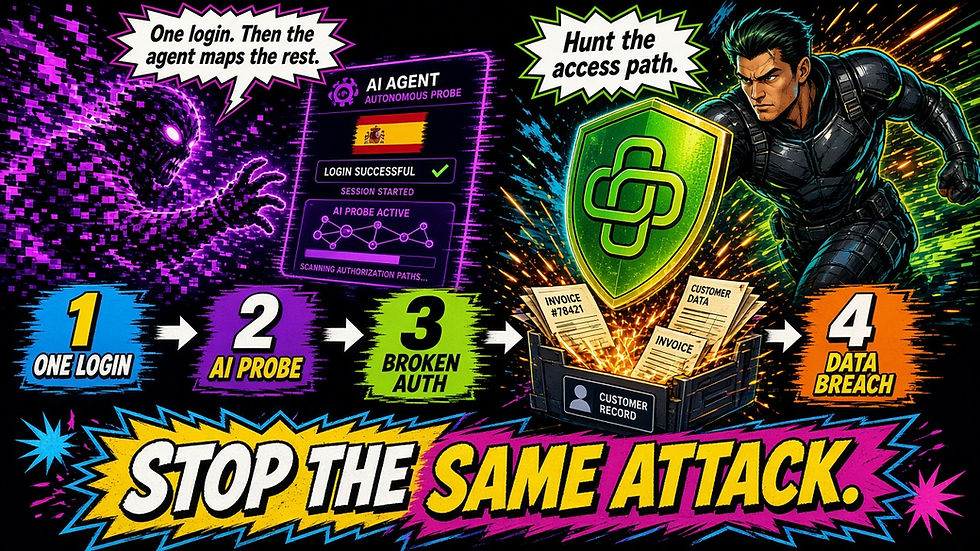
One successful login. What could happen next inside your business?
A customer portal opens. Invoice records become reachable. A low-privilege account encounters functions it should never control. If an attacker can connect those opportunities quickly, a login alert may arrive after the business damage has started.
Spain’s reported AI agent data breach makes that question timely. The useful response is to examine the access paths, authorization decisions, and response capabilities an attacker could exploit—then test whether your organization can interrupt them.
Analysis date: September 17, 2026. This is Inception Security’s defensive assessment of a public notification, not a forensic report on the affected organization. Conditional scenarios below are hypotheses to investigate, not findings about this incident.
What Spain’s AEPD actually reported
On September 14, Spain’s data protection authority, AEPD, published notice of a reported breach involving an AI agent using a well-known language model. The account describes searching generic files for vulnerabilities, a successful login, subsequent autonomous application probing, changes to personal data, and access to invoices.
AEPD explicitly says the information comes from the affected organization’s notification and requires analysis. It does not establish that the model or its provider was compromised. “First notification” refers to the authority’s reported experience; it does not prove a world-first attack or a statistical trend. Read the original AEPD notice in Spanish.
The notice does not disclose the victim’s identity, affected product, specific vulnerability, model name, record count, attack duration, or technical evidence establishing the extent of autonomy. It also does not explain how the successful authentication occurred. Those gaps materially limit attribution and root-cause analysis.
The central question: which trust boundary failed?
Our assessment is that defenders should evaluate several independent boundaries: reaching an application, obtaining a session, accessing a particular customer’s record, changing a sensitive field, and moving information outside the authorized workflow. A control at one boundary does not automatically protect the others.
A valid session answers an authentication question. It should not grant permission to every record, every action, or every business process. Similarly, an application returning a successful response proves that a request was processed; it does not prove the request was appropriate.
For a small business, the most useful exercise is concrete: start with an ordinary employee or customer account and document everything it can read, change, export, delegate, and connect. Then ask what damage becomes possible if someone else controls it.
Attack analysis: five stages to investigate
The following is an investigation framework. It is not a verified chronological reconstruction beyond the limited sequence described above.
1. Discovery: what could an outsider learn before signing in?
Investigators should establish which routes were requested before authentication, what responses they returned, and whether any exposed material revealed application structure or secrets. Possible candidates include old deployments, diagnostic pages, misplaced configuration files, and forgotten API versions. None is established as the entry point here.
What could have been done differently? Assign an owner to every internet-facing application. Remove unnecessary exposure, review deployment artifacts, and prioritize vulnerabilities based on reachable business impact. A technically severe issue on an isolated test system and a modest flaw on an exposed billing portal require different operational attention.
Evidence to request: reverse-proxy and application access logs, deployment records, the exposure inventory, and preserved versions of publicly accessible files. Confirm whether the same routes remain reachable today.
Hard question: Can your team explain why each exposed application must be public and what sensitive system it can reach?
2. Authentication: what does “successful login” actually mean?
A successful login alone cannot distinguish a stolen password from an attacker-controlled registered account, an abused recovery flow, a compromised session, or another authentication weakness. Each possibility changes the corrective action. Do not write a root-cause statement that says “missing MFA” unless evidence supports it.
Our recommended review separates interactive user sign-ins, application sessions, API credentials, and service identities. Check which authentication policies actually applied to the relevant application and whether local login or recovery paths bypassed the intended identity provider.
Controls to evaluate: phishing-resistant MFA for supported user workflows, protection of recovery methods, removal of obsolete authentication paths, narrowly scoped service credentials, and a tested session-termination process. These are layered safeguards, not proof that any one would have stopped this case.
Evidence to request: authentication method, MFA and policy results, account creation and recovery events, session issuance, device context, token use, and application-local authentication logs. Avoid treating an unfamiliar IP address as sufficient attribution.
Hard question: If you disable an account now, which application sessions or integration credentials could remain usable?
3. Application probing: could a normal account reach abnormal functions?
After access, investigators should examine the difference between the account’s intended permissions and what the application allowed. Plausible hypotheses include excessive assigned privileges, missing record-level checks, missing function-level checks, or another application vulnerability. The public notice does not identify which occurred.
OWASP distinguishes broken object-level authorization, where access to a particular record is not properly enforced, from broken function-level authorization, where an unauthorized role can invoke an operation. A logged-in customer may legitimately use an invoice endpoint but still be forbidden from reading another customer’s invoice or invoking an administrative export.
Controls to evaluate: server-side authorization for each object and action, tenant isolation, deny-by-default permissions, and regression tests covering multiple roles and organizations. Hidden buttons and difficult-to-guess identifiers are not substitutes for authorization.
Evidence to request: relevant request routes, response outcomes, account roles at the time, authorization decisions, and controlled reproduction using synthetic records. Compare the intended access policy with actual behavior.
Hard question: When did you last demonstrate that Customer A cannot read or modify Customer B’s records through the API as well as the interface?
4. Data access and modification: protect integrity as well as confidentiality
Reading information and changing information create different response obligations. Our investigation plan would separately identify records viewed, fields changed, exports created, and downstream systems that consumed the changes. Invoice access by itself does not establish payment diversion, bulk exfiltration, or financial loss.
Consider the potential business consequence of an unauthorized edit: a billing contact changes, a workflow routes to the wrong person, or a trusted report incorporates corrupted data. These are scenarios to assess, not outcomes documented in this case.
Controls to evaluate: separate read and write permissions, field-level restrictions, independent approval for high-impact changes, transaction limits, version history, and recoverable backups. Sensitive payment changes should require verification through a previously established channel.
Encryption at rest remains useful, but an authorized application may decrypt information for a compromised session. Backups support recovery; they do not reverse disclosure. DLP may help with some export channels but cannot be assumed to observe every application response.
Hard question: Could you identify and reverse malicious edits without overwriting legitimate work completed afterward?
5. Detection and containment: who can stop the next action?
The critical design question is how long harmful access can continue after the first actionable signal. We cannot infer the actual attack speed or defender response time from this notice. We can test our own.
Our proposed detection approach correlates account or session context with application behavior: unusual record breadth, repeated authorization failures followed by success, sensitive field changes, new export activity, and access outside the role’s normal workflow. Fast request rates may help identify abuse, but automation can operate slowly and legitimate integrations can operate quickly.
Controls to evaluate: application-aware monitoring, named responders, preauthorized containment for narrowly defined high-confidence conditions, and escalation for uncertain cases. Possible actions include suspending a session, restricting an export route, disabling a compromised integration, or isolating an affected host when host compromise is supported.
Test each action’s business impact and reversal process. An attacker may deliberately trigger a poorly designed response to disrupt legitimate operations.
Hard question: At 2 a.m., who has both the evidence and authority to stop suspicious invoice activity?
Which controls would interrupt which attack paths?
These are conditional recommendations. They describe where a safeguard helps and where another layer is still necessary.
Risk scenario | Control to prioritize | Important limit |
Exposed application or deployment artifact | Asset ownership, exposure reduction, secure deployment review, timely remediation | A vulnerability scan may miss business-logic flaws. |
Compromised user authentication | Strong authentication, recovery protection, context-aware access, session controls | Does not fix permissions inside the application. |
One account reaches another customer’s records | Server-side object authorization and tenant isolation tests | Must cover every relevant read, write, and export path. |
Read access becomes a harmful edit | Separate privileges, sensitive-field restrictions, independent approval | Approval fails if the approver or alternate path is compromised. |
Abuse continues while alerts wait | Correlated monitoring and tested containment authority | Automation needs reliable context and safeguards against disruption. |
Records are changed or disclosed | Audit history, reconciliation, restoration, exposure assessment | Recovery cannot undo information already disclosed. |
What AI changes—and what the evidence does not establish
For threat modeling, an agent can be treated as a mechanism for choosing and executing successive actions using tools and feedback. The defensive concern is that a weak access path may be explored repeatedly with less manual effort between steps. That does not establish a particular speedup, success rate, or level of autonomy in this incident.
Our position is to design controls around the action and its authorization. A request to change a protected record should fail when permission is absent, whether the caller is a human, script, or AI agent. A detection should investigate harmful behavior without waiting to prove which model produced it.
To substantiate an “autonomous attack” claim, investigators would ideally correlate application events with available agent execution records, tool calls, prompts, operator interventions, and timestamps. Model outputs describing an attack are not equivalent to evidence that those actions executed successfully. Attribution may remain uncertain even when unauthorized access is well established.
This also differs from a company employee accidentally sending information to an approved AI assistant. An internal AI-use policy addresses the company’s own deployment choices; it cannot govern an external attacker. For internal adoption safeguards, see our 10 AI security steps for small businesses.
What Microsoft 365 businesses should examine
There is no public basis to say this incident involved Microsoft 365. The following applies the analysis to Microsoft-centric SMBs.
Start with the systems connected to Entra ID, but include customer portals and applications that retain separate local authentication. Review policy coverage, exclusions, privileged access, guest access, service accounts, and application permissions. Map each sensitive business workflow to the identity and application controls that actually protect it.
Microsoft documents Token Protection as a control against replay of device-bound sign-in session tokens in supported scenarios. It is not universal protection for every browser session or SaaS application. Verify the current platform, client, resource, configuration, and licensing requirements before relying on it. Microsoft Token Protection documentation.
Our recommended validation is end-to-end: demonstrate which sessions terminate after revocation, whether an application-local session persists, and whether an integration can continue under its own identity. Review available interactive and noninteractive sign-in evidence alongside application audit records. A clean endpoint console cannot establish that a cloud application has not been abused.
For your own agents, assign distinct identities where supported, tightly scope accessible data, separate read from write actions, and require enforced approval for consequential operations. Keep permission enforcement in the application or integration layer rather than relying only on a prompt that tells the agent to behave.
How we would investigate a similar incident
Inception Security’s proposed investigation would pursue containment, evidence preservation, and impact assessment together. A live threat may require immediate action before a complete evidence collection.
Preserve the time window. Export relevant identity, application, proxy, database, and cloud audit records before retention expires. Record time zones and clock differences. Document collection provenance and protect evidence integrity.
Build an action timeline. Join authentication, requests, authorization results, reads, edits, and exports using reliable identifiers. Do not equate a shared IP address with a shared actor.
Determine the reachable scope. Reconstruct the account’s permissions at the incident time, including inherited roles, integration access, and changes during the event.
Assess record impact. Separate observed access, confirmed changes, demonstrated exports, and uncertainty caused by missing logs. Avoid declaring “no exfiltration” solely because no download alert fired.
Contain and validate. Revoke relevant access, address the exploited path when identified, and verify that alternate sessions or credentials no longer work.
Recover business accuracy. Reconcile affected records with trusted history and downstream owners. Validate restoration with finance or operations, not only the infrastructure team.
For logging design, OWASP recommends recording useful event context while protecting logs and excluding sensitive secrets. OWASP logging guidance. Our suggested application record includes actor, tenant, target object, attempted action, authorization outcome, timestamp, and correlation identifier. Avoid logging raw session tokens, passwords, or full confidential documents merely to improve visibility.
Compliance: the AI label does not replace breach assessment
Where GDPR applies, Article 33 requires controller notification to the competent supervisory authority without undue delay and, where feasible, within 72 hours of awareness, unless the breach is unlikely to create risk to individuals’ rights and freedoms. Processors notify the controller without undue delay. Article 34 addresses communication to affected people when high risk is likely, with specified exceptions. The regulation also requires breach documentation. GDPR Articles 33–34.
Do not wait for certainty about AI attribution before assessing an established personal-data incident. Engage the appropriate privacy and legal owners to determine applicable jurisdictions, sector rules, contracts, notification thresholds, and deadlines. U.S. SMBs should not assume that Spain’s regulatory framework automatically governs them.
Our recommended decision record distinguishes known facts, assumptions, missing evidence, likely affected data, containment actions, and the reasoning behind notification decisions. Security improvement and legal compliance are related workstreams; completing a technical checklist does not certify compliance.
A practical 30-day risk-reduction plan
Days 1–3: identify the highest-consequence paths. The IT lead and business owners should list exposed customer, billing, and administrative applications; identify the accounts that can change sensitive records; confirm log availability; and name the after-hours decision-maker. Deliverable: an owned inventory and a short list of urgent exposure or access fixes.
Days 4–10: reduce access and test boundaries. Application owners should remove unnecessary privileges, validate authentication coverage, review integration credentials, and perform authorized cross-role and cross-tenant tests with synthetic data. Deliverable: documented failures, remediation owners, and retest results.
Days 11–20: make activity observable and stoppable. Security and application teams should implement a small set of relevant alerts, connect identity and application context, and test containment against an approved scenario. Deliverable: evidence that the alert reaches a person who can stop the tested activity.
Days 21–30: rehearse recovery and governance. Run a tabletop involving IT, finance, leadership, and privacy/legal owners. Practice a suspicious login followed by unauthorized invoice changes. Deliverable: a corrected playbook, a demonstrated restoration process, and a funded plan for remaining gaps.
Track outcomes: percentage of sensitive applications with verified authorization tests; proportion of critical actions with usable audit trails; observed time to contain the test session; and ability to reconcile altered records. Choose targets based on business impact. These are suggested internal measures, not industry benchmarks.
Questions leadership should ask this week
What can our least-privileged customer or employee account actually reach?
Which important applications are missing from our identity and monitoring coverage?
Where does one account have permission to both initiate and approve a sensitive change?
Can we distinguish a legitimate bulk workflow from unauthorized record collection?
Which controls have been demonstrated in a test, rather than accepted from a policy document?
If our main identity provider is secured, what independent credentials remain in our applications?
What evidence would let us tell a customer exactly which records were affected?
Who owns the residual risk when a necessary fix cannot be completed immediately?
Frequently asked questions
Does this prove an AI agent can defeat any company’s security?
No. The available disclosure is too limited to establish that conclusion. Assess your own reachable systems, permission boundaries, and response performance rather than generalizing from an unverified technical account.
Would MFA alone prevent an AI-assisted breach?
No single authentication control covers all the scenarios examined here. MFA can strengthen user authentication, while application authorization, session security, and integration controls address different risks. Prevention depends on the actual attack path.
Should SMBs ban AI tools because of this report?
A blanket internal ban would not stop an outside attacker from using automation. Govern your own AI deployments and protect the systems an external attacker could reach. Both deserve attention.
What should a small business do first?
Choose the application whose misuse would cause the most harm. Identify its owner, verify who can access and change its data, test the permissions, and rehearse stopping a suspicious session. Use the results to prioritize wider improvements.
Find the access paths before an attacker does
The decision for an SMB is practical: which reachable identity or application could expose customer data or alter business records, and what evidence shows that the path is controlled?
Start with Inception Security’s free Microsoft 365 security assessment to identify tenant security gaps and prioritize improvements. For application exposure, authorization testing, or a broader risk program, discuss scope through our cybersecurity advisory services. A Microsoft 365 configuration review and a web application security assessment answer different questions; scope the work around the systems that hold your risk.


